
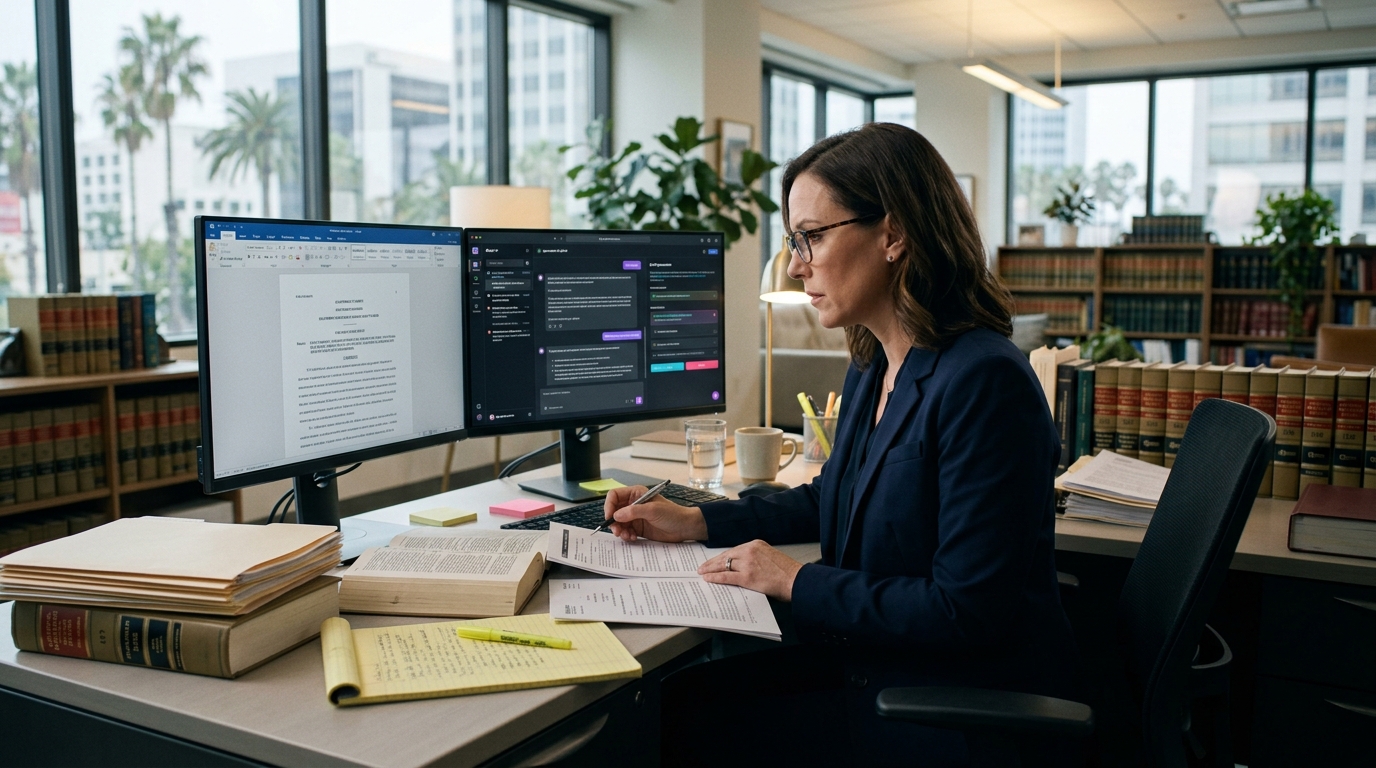
The California AI rules for lawyers 2027 will change how attorneys use generative artificial intelligence in legal work. California Senate Bill 574 creates new duties involving confidentiality, accuracy, court filings, citations, and professional judgment.
The law matters even if a client never uses an AI tool personally. A lawyer might use generative AI to organize information, draft language, research an issue, summarize records, or assist with another legal task.
Starting in 2027, California attorneys who use these tools must follow specific safeguards. They cannot delegate the practice of law to artificial intelligence. They must also take reasonable steps to check AI output and correct false or hallucinated information.
Another major change affects court filings. Attorneys must disclose generative-AI use to the court for documents submitted to the court. Filed papers also cannot contain citations that an attorney responsible for the document has not personally verified.
This guide explains what SB 574 changes, what clients can reasonably ask their lawyers, and what the new law does not mean.
What the California AI Rules for Lawyers 2027 Actually Require
SB 574 adds a new section to California’s Business and Professions Code and changes parts of the Code of Civil Procedure.
The law does not ban lawyers from using AI. Instead, it places responsibility on the human attorney who chooses to use it.
That distinction is important. Generative AI can help produce text quickly, but it can also generate false facts, invented cases, incorrect quotations, or legal rules that do not apply to the client’s situation.
A lawyer cannot avoid professional responsibility by saying that software produced the mistake.
AI Can Assist a Lawyer, but It Cannot Replace Legal Judgment
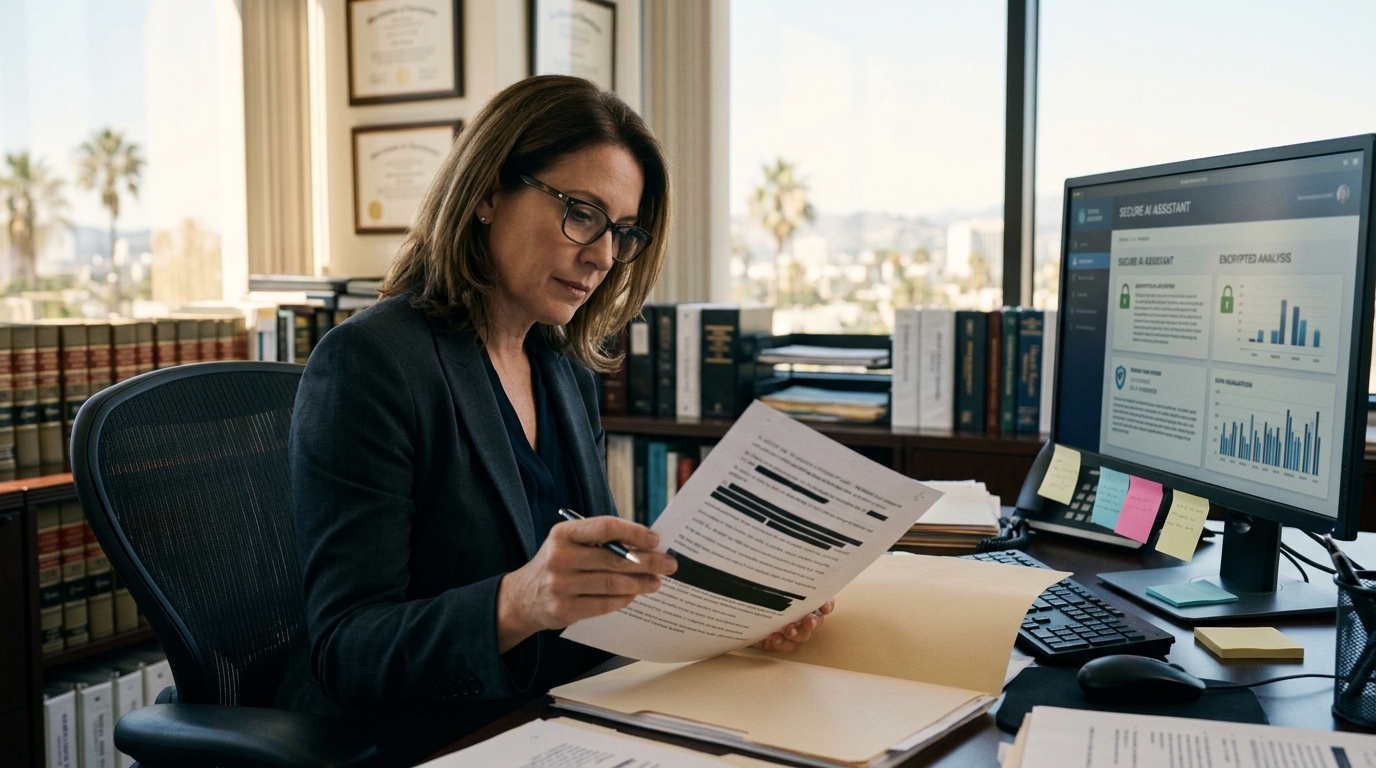
One of the clearest parts of SB 574 says an attorney may not delegate the practice of law to generative artificial intelligence.
In practical terms, AI can serve as a tool. The attorney must remain responsible for the legal work.
That includes deciding which arguments to make, which authorities apply, what advice to give, and whether an AI-generated statement is accurate.
This becomes especially important in cases where the facts are disputed. A criminal case, divorce, custody dispute, employment claim, or injury lawsuit may turn on details that an AI system cannot independently verify.
Our AI Evidence in Criminal Courts guide explains a related problem. Artificial intelligence can affect both the creation of evidence and the way lawyers analyze it. Courts still need reliable evidence, authentic records, and legally supported arguments.
Client Confidentiality Limits What Lawyers Can Enter Into AI Systems
SB 574 creates specific protections for confidential and nonpublic information.
An attorney who uses generative AI cannot place confidential, personal identifying, or other nonpublic information into a system unless access to that information is properly restricted.
The statute lists several examples of personal identifying information. These include Social Security numbers, driver’s license numbers, dates of birth, addresses, phone numbers, medical or psychiatric information, financial information, and account numbers.
This issue can arise easily in normal legal work.
Imagine a lawyer asking an AI tool to summarize a medical record. The document may contain a client’s name, date of birth, diagnosis, address, insurance information, and other private details.
A lawyer cannot simply paste that information into any public AI service without considering who can access the data and whether confidentiality is protected.
Clients can reasonably ask a law firm whether it uses AI tools and what steps it takes to protect confidential information.
That does not mean every firm must reveal its entire technology system. It does mean confidentiality remains a lawyer’s responsibility when new technology is used.
Lawyers Must Check AI Output and Personally Verify Citations
Generative AI can produce information that sounds convincing but is false. These errors are often called hallucinations.
A legal hallucination can be especially serious when an AI system invents a court case, changes a quotation, gives the wrong statute, or describes a real decision inaccurately.
SB 574 requires attorneys who use generative AI to take reasonable steps to verify its output. Attorneys must also correct erroneous or hallucinated material they use.
The law goes further when court filings contain legal citations.
A brief, motion, pleading, or other covered paper filed in court cannot contain a citation that an attorney responsible for submitting it has not personally verified. The rule applies even if the citation did not come from AI.
This point matters because citation verification is broader than checking whether a case name exists.
The attorney should confirm that the authority actually supports the legal statement being made. A real case can still become a bad citation when it is quoted incorrectly or used for a rule it never established.
The new requirement builds on a problem courts have already encountered. Lawyers around the country have faced sanctions after submitting filings containing fictional AI-generated authorities.
The lesson for clients is simple. AI can make drafting faster, but speed does not remove the lawyer’s duty to verify the work.
Court Filings and Arbitration Receive Additional AI Rules
SB 574 also creates a disclosure requirement.
When an attorney uses generative AI to assist with documents submitted to a California court, the attorney must disclose that use to the court.
The statute does not turn an AI-assisted document into an invalid filing. It creates transparency around how the legal work was produced.
This can matter because judges need to know that an attorney has reviewed the filing rather than relying blindly on automated output.
California has already been developing AI standards inside the judicial system. Judicial officers have guidance on accuracy, confidentiality, bias, security, and human oversight when using generative AI.
An AI Disclosure Does Not Automatically Mean the Filing Is Unreliable
Clients should not assume that an AI disclosure means something went wrong.
An attorney might use AI for an early outline, grammar assistance, document organization, or another limited task and then independently review the final work.
The key question is not simply whether AI was used. The more important question is whether the attorney maintained professional judgment, protected confidential information, and verified the finished document.
Implementation details may also develop over time. The statute requires disclosure, but courts may provide additional procedures or guidance about how disclosures should appear.
Arbitrators receive their own restrictions under SB 574.
An arbitrator cannot delegate the decision-making function to generative AI. The law also imposes disclosure requirements in certain situations involving AI-generated material outside the record.
This matters because arbitration can resolve employment, business, consumer, and other disputes without a traditional courtroom trial.
The person chosen to decide the dispute must still make the decision.
Readers interested in another area where artificial intelligence is complicating legal proof can read our Deepfake Evidence in Divorce and Child Custody Cases guide.
What Clients and Court Users Should Do When AI Is Part of Legal Work
The new law does not require clients to become AI experts.
Most people hiring a lawyer need clear answers about their case, fees, risks, deadlines, and possible outcomes. Those basic needs do not change because a firm uses new technology.
Still, clients may want to ask a few practical questions when AI plays a meaningful role in the work.
For example, ask whether the firm uses generative AI with client records. Ask how confidential information is protected. You can also ask whether a lawyer reviews AI-assisted research before relying on it.
These are technology versions of questions clients have always had a reason to ask: Who is doing the work, how is it checked, and how is my private information protected?
AI Rules Do Not Replace Normal Lawyer and Court Responsibilities
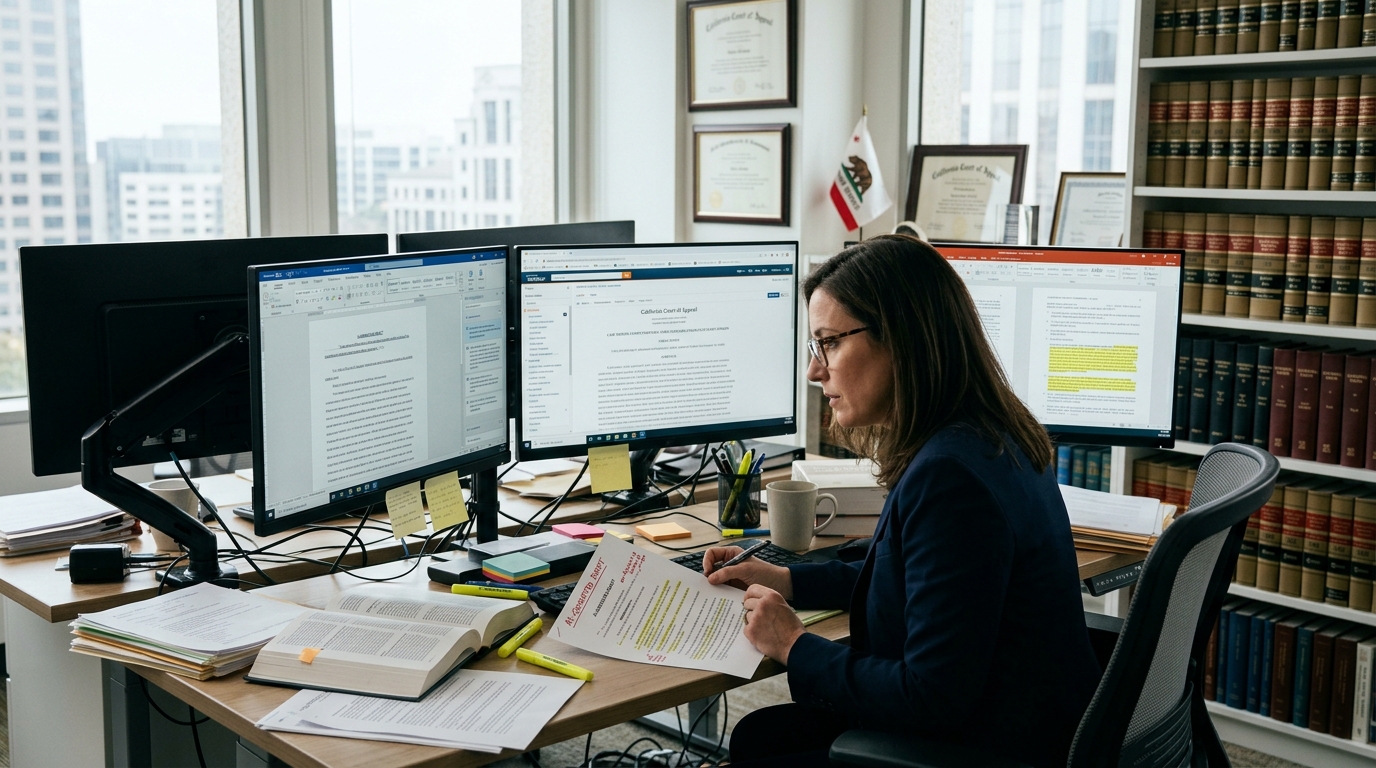
SB 574 should not be understood as permission to treat AI output as legal advice.
A generative AI system does not know every fact in a dispute. It may not know the latest local court procedure. It can also confuse laws from different states or use outdated information.
Local context remains especially important.
City Law Guide exists in part because legal procedures can vary by city, county, court, and state. Filing locations, deadlines, local rules, government agencies, and court resources may differ even when the general legal issue sounds similar.
The same caution applies to self-represented court users.
The California Supreme Court has published guidance explaining that AI can sometimes help people organize ideas, understand legal terms, or draft material. However, court users remain responsible for checking what the tool produces.
Use AI as a Starting Tool, Not as a Substitute for Verification
A self-represented person might use AI to simplify a legal term or help organize questions for a court self-help center.
That can be useful.
It becomes risky when a person copies an AI answer directly into a court filing without checking the law, court forms, local rules, or cited cases.
California Courts advises users to verify sources, confirm that forms and information come from trusted California resources, and avoid placing private information into public AI systems.
People should also remember that SB 574’s attorney duties apply to lawyers. A self-represented litigant does not become protected simply because an AI tool created the document.
The person filing the paper remains responsible for what is submitted to the court.
California AI rules for lawyers 2027
For business owners, AI rules can reach beyond litigation. Privacy laws, employee data, automated hiring, and customer information can create separate compliance questions. Our 2026 State Privacy and AI Laws for Small Businesses guide covers that broader landscape.
The California AI rules for lawyers 2027 show how the legal profession is moving toward regulated AI use rather than a simple ban.
California attorneys may continue using generative AI as a tool. However, they remain responsible for the legal work it helps produce.
They must protect confidential information. They must take reasonable steps to verify AI output. Must correct hallucinations. Court filings require AI disclosure when generative AI was used, and filed citations need personal verification by an attorney responsible for the document.
Clients should view those rules as accountability measures rather than reasons to fear every law firm that uses technology.
A careful lawyer can use new tools while still protecting confidentiality, verifying legal authorities, and making independent professional decisions.
The central principle remains familiar: technology can assist legal work, but responsibility stays with the human professional.
For the latest statutory language and implementation updates, review the official California legislative and Judicial Branch materials before relying on an AI-related court procedure.
Legal note: This article provides general educational information and does not give legal advice. Court procedures and the effect of a new statute can depend on the case, jurisdiction, and later rules or judicial decisions.